All posts by adrian

J is Unmistakeably for Martyn Joseph

I have old favourites I have followed since the sixties or seventies; Beatles, Bowie, Neil Young and Joni will always hold a place in my heart, though their belated offerings give diminished returns as the years’ progress.  There are perennial idols too in Dylan and Leonard Cohen that I return to time and time again, and who are still capable of greatness even in older age.  Then there are the younger ones, who emerged maybe in the eighties or nineties and who are still writing and performing great music.

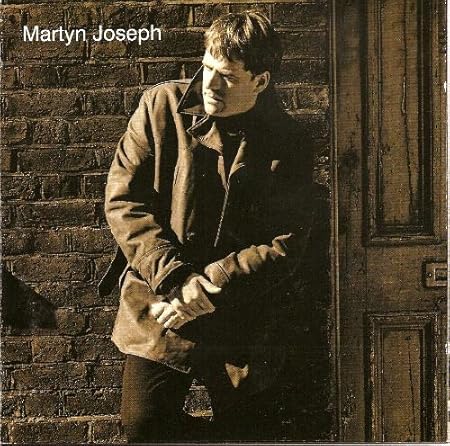
And the best of these late bloomers is Martyn Joseph; Welsh boy supreme.  He is almost a latter day Dylan (without the dose of vituperation) singing songs of protest, of Wales, of love and despair, and of hope.  He started off on Sony and I think they wanted to turn him into some sort of a ‘pop-star’.  He turned away from them and has ploughed his own furrow ever since.  He plays live constantly and is very popular in Canada as well as Europe and here.  He has his own record company and sells mostly by e-mailing his constant fans with news of concerts and new albums.  Because he isn’t tied to a big record company he releases something almost every year, and has indulged himself by whole albums of covers and a few live concerts.  But he still writes enough new good material to fill whole studio albums too.  He can rage and play rock’n’roll and can sing ballads too, descending almost to a whisper in the tender lines.

I have seen him live almost every year for a while now, and he never disappoints, creating an intimate atmosphere, as if he is singing just for you.  He also has a habit of shaking his audience by the hand as they leave the auditorium.  He genuinely doesn’t want any more fame than he has, and to make enough money to keep going and making music seems his only goal, except, in his quiet way, raising our consciousness that there is a different way than the greedy materialistic war-mongering road the world seems intent on.

More than all the others he is the one I admire most, to have made a career out of music without compromising his soul is a great achievement.
The Perils of Internet Booking

Tuesday 16th April

There is a particular dread which overtakes one when booking or buying something  expensive on the internet.   That moment when you aren’t quite sure whether the purchase has happened, when you wait and wait and the computer seems to go really slow before the confirmation page appears.  And then there are the ridiculous hoops to jump through before you can actually get to the important bit – paying for it.

And Ryanair must be the very worst site in the world.  It is designed to trip you up at every step, to make you pay for things you don’t want.  It needs steely determination and a constant concentration to navigate the pages and un-tick boxes, and scroll down the whole list of options to find the ‘no, I will travel without insurance’ option.

Then when you get to the last bit and enter your credit card details and press CONFIRM the whole site freezes.  Actually it seems to make the whole computer freeze.  And the computer has frozen, nothing works except unplugging it and re-booting.  So you start again and avoiding the minefield of extra charges get to the same point, finding by the way that the bizarre pricing policy has somehow added £5 more to your total bill than you would have paid if the previous five minute ago sale had actually gone through.  Again that agonizing wait until you get the Confirmation page, and see that the e-mail has popped up in your in-box.  Oh, the relief of it.

Then you are never quite sure if you might have booked two tickets in error.

How much simpler it was when you could just phone up and talk to someone who would take your details and answer all your questions and tell you that the tickets were in the post.

I know that the internet is progress, but as so often happens – progress comes at a price.

Day 104, and at last Sunshine

Monday 15th April

Sunday was the one hundred and fourth day of the year, and at last the sun is shining.  We have had to wait for almost a third of the year for a bit of warmth, that golden glow on your skin that almost tells us we are alive.  Whatever the size of the greater Universe, the Cosmos, the Milky Way – it is almost certainly true that in our Solar system everything revolves around and needs the sun.  Maybe every plant and creature understands this without being told.  Children certainly know it, as their faces come alive as the sun’s rays cross their little features.  And even the most cynical and cold-hearted of us adults know it too.

The sun is what gives us life, and without it we are all doomed.  For years I have worked in tiny airless basement offices and through the winter I travelled to and from work in darkness only to sit and slog all day and never see the sun.  Things have improved of late and mostly I can glance up and see a small patch of blue sky between the buildings opposite.  And yet for these last few months it has felt as if I were still in the basement.

So raise a glass to our old friend the sun who has come out to welcome us after a long absence.  We should celebrate because you never know this could just be the last beautiful sunny day of the year.

That’s Enough of Thatcher, Surely

Sunday 14th April

Three blogs must be enough for anyone, and if you add up all the millions of words, articles, news reports, interviews and discussions since her death one has to wonder if enough is enough.   And surely it is.

There is no doubting the Thatcher effect though.  She had the ability all through and after her Premiership and even in death to be divisive.  Such is the nature of dictators.  And one of her main claims to fame was that she was never defeated (as neither was Blair of course) and of course she never knew when to give in and retire quietly either.

But one interesting aspect of her death has been that because of all the interest and memories that have been aroused, there has been a re-awakening of politics.  Suddenly people who were happy to declare that all politicians are the same are talking again about politics.  And not just the bread and butter issues, but the more fundamental nature of politics.  Whether there is such a thing as society?   Whether Greed is ever good?  And what sort of a world we want our kids to grow up in.

Whether her passing will change anything at all one never knows of course.  It may all fizzle out and  in a few months time we will wonder what all the fuss was about.

But it has certainly been interesting.  And whatever you think about Osborne and Cameron and Clegg and Milliband, the only certainty is that no-one will be talking about them thirty years after they were in power.

Thatcher – The End of Cabinet Government

Saturday 13th April

As you may be aware I am in the process of reading the entire works of Anthony Trollope.  These books (over 50 of them) were written in the latter half of the Nineteenth Century; that is about 150 years ago.  They are highly political, in that while generally favouring the Whig cause they show us in great detail just how the political process was conducted.  And back then the Cabinet system was already being used.

The idea of a Cabinet is that it is comprised of the leading figures of a particular party who agree to serve under an individual who is the Prime Minister.  The Prime Minister is the figurehead of the Cabinet and is there by their express permission and the Cabinet agrees to serve under him (or her) and brings forward a collectively decided programme of Bills to be presented to Parliament.

Until very recently it used to be the case that although a Prime Minister appointed his Cabinet and distributed the portfolios there had to be consensus in the Cabinet for measures to be adopted.  If a Cabinet member could not agree then he (or she) could resign.  The Prime Minister could also sack a Cabinet Minister, but this has always been a dangerous precedent.  In the words of, I believe Al Haig, ‘It is better to have the bastard pissing out of the tent than outside pissing in.’

But we have been gradually moving to a Presidential style where the PM is all important and although the country has elected the party it is the PM who has all the power.  This came to a head with Thatcher, whose first Cabinet did contain all the leading big beasts of the then Tory party, but which gradually became a Cabinet of yes men ‘those who were for us’ and anyone who disagreed with her was dumped.  This marked the end of Cabinet Government, and it has never been fully re-instated since.  Major tried and failed, Blair may have talked of consensus but was almost as brutal as Thatcher at getting rid of ‘dissidents’ – he baulked at moving Gordon Brown, but maybe he should have.  Brown was another, though weaker, despot who liked his Cabinet to be subservient to him, as it mostly was.  Cameron fortunately lost the only real ‘difficult’ Cabinet member when Liam Fox had to leave, and has a pretty subservient duopoly, because Osborne has almost as much influence as Cameron.

And maybe this is why we have such bad policies.  There is far too much power in the hands of one man (or woman) rather than real collective decision making, where some sort of wisdom may emerge.  We now do not elect a party, but a Leader who tries to dominate his Party instead of listening to all opinions and actually pursuing policies that people might have voted for.

Margaret Thatcher – A Media Star

Friday 12th April

Amidst all the analysis of Thatcher which has so dominated the news there has been little discussion of the way the media played such a part in her success.  Interest in her was first sparked because of her surprise victory in winning the Conservative leadership, if only as novelty value because she was a woman.  And, nervous at first, she soon became adept at manipulating both her image and her message.  At that time there was a natural deference towards women, a politeness which was not afforded by men to fellow men, and she was rarely contradicted or bullied by interviewees.  In fact the only embarrassing moment in all her stage-managed television interviews was when an ordinary woman refused to be bullied by her (it was about the ship Admiral Belgrano sailing away from the Falklands when it was sunk) and stuck to her guns and made Thatcher look ridiculous.   After that she was kept well away from ordinary people who were not intimidated by her.

Before her the media were hardly used by politicians.  She was fortunate in having allies like Murdoch and the Mail and Telegraph who couldn’t believe their luck that a real Tory was back in power.  Then there was Bernard Ingham, a recent convert to Thatcher who was belligerent and bullied television and any newspapers not falling into line with the Thatcher version.  Ingham makes Alistair Campbell look like a poodle.  And so the myth of Margaret was created.

At the time I thought she looked ridiculous on top of a tank with her scarf wrapped round her head, but Lord Bell her PR guru used this and more and more ludicrous images of her which many in the public lapped up.

Despite the folk memory of her massive popularity, even with a divided opposition she never won more than 43% of the vote, which was matched by Blair and beaten by the ‘unpopular’ John Major.

So much that is spoken of her is a myth, and now that she has died the myth will continue.  Thank God she died two years before the election and not during it, where real damage might have resulted.  Rest in peace, and please media – give us a little peace too.

The Truth About Inflation

Thursday 11th April

The truth about inflation is that if it is between 5 and 10% it is actually a good thing.  We hear stories all the time about people who bought their houses in the seventies for a couple of thousand pounds and are now worth a hundred times that amount, or more correctly after buying and selling and taking out larger and larger mortgages on successive houses they now own a house in the hundreds of thousands.  How was this achieved?  Not by some brilliant financial management on their part but simply because of inflation.   When inflation is relatively high as long as your wages rise roughly in line with it you get better off.

Mortgages and other debts such as HP are usually a fairly fixed amount for a long period, so a monthly payment of a couple of hundred pounds that was say 50% of your net pay at the beginning of the loan after five years of ‘healthy’ inflation is suddenly only 30% or less of your expenses; gving you the opportunity to borrow more to either buy a larger property or to spend on material goods.

This was what happened through the seventies, eighties and nineties and to a lesser degree through the naughties too.  It fueled an ever increasing rising standard of living and had very little to do with economic policies being pursued at the time.  Despite the claims of Thatcher worshippers, GDP during the eighties was only 1.4%, compared to a post war average of 2.5% and was much higher during the so-called failure years of Wilson, Heath and Callaghan.

The misguided policy of the Bank of England (and central banks all over the world) of keeping interest rates so low has resulted in worthless savings and a stagnation that risks becoming permanent.  We actually need a bit of inflation in the system to promote growth and spending.

The only people benefiting from low interest rates are mortgage holders, but they would have benefited far more from a higher inflation and higher interest on their loans. I cannot see my kids, whose houses are all worth more or less just what they paid for them over five years ago ever seeing the huge financial rewards my generation saw from the simple result of inflation.

Thatcher – A Lucky Politician

Wednesday 10th April

I met Margaret Thatcher twice at official functions in Finchley; each time she was charming, even though I was representing the Labour Party.  I believe that the persona she displayed on television was all an act, some sort of self-glorying in the image that was created for her by a worshipping media and an obedient party.  There is no doubting that she was brave and single-minded and bludgeoned her way through all opposition.  She was also lucky.

She was lucky that the Argentinians were stupid enough to invade the Falklands with an ill-trained and inadequate force, although we really do not know how any other Prime Minister in charge might have reacted.  I suspect that almost all would have sent forces to reclaim the islands, with possibly less loss of life than happened under Thatcher.  But the resulting victory changed her fortunes too.  Before that she was on the rocks politically; her economic policies were creating high inflation and even higher unemployment and her poll ratings were dire.  She was heading for defeat at the general election.

She was lucky too that the Labour Party was tearing itself apart; the gang of four had left and set up the SDP and the left was going bonkers too.  Mchael Foot did his best to hold the party together but was never likely to be elected as a Prime Minister, he just didn’t look the part.

She was lucky that she had a worshipping press, orchestrated by a young Rupert who saw her as the way of changing the country the way he wanted it to go.

She was lucky in having Arthur Scargill go on strike without a ballot and leading the brave miners to a glorious defeat, although rarely has such venom towards a whole class of people been shown by a so-called leader.

And many people lapped it up, so much so that by 1985 she had become an elected Dictator who could do no wrong and the myth-making which we see today was set in motion.

There is no doubting her determination, her political skill and her success, but she also had luck.

Wasting my Time

Tuesday 9th April

I had a day to myself on Sunday, and I blew it away.  Oh, I checked my e-mails and did catch up on my one private client, so I suppose that counts for something.  But the overall feeling I had was that I had wasted my day; too much bored laying on the sofa, swapping news channels and trying to find something to shake me out of my ennui.

So, where does this come from – this feeling of guilt at doing what the vast majority of people probably aspire to.  There have been many times in the past when I have deliberately filled up my day with work to stop myself from going quietly mad.  I was brought up in a fairly strict respectable working class family where the devil made work for idle hands.  Sundays involved Sunday School and attending the service, finishing homework before lunch, then as a family we invariably went somewhere or had visitors on Sunday afternoon.

Not exactly strict Victorian work ethic, but close to it.  And I find I still need a project or I dissolve into just that sort of mood which overtook me on Sunday.

For 18 months I was between partners and far too many Sundays I allowed to slip away just like this one.  Am I so useless that I need someone to be constantly kicking my arse?  Or is it the natural rebellion when one is at last freed from that arse-kicking?

Anyway, no more.  I have resolved to not allow that to happen again.  If I am on my own I will work on the book, which I have of course neglected for far too long.  No more wasting my time.  You hear that mother?

The Great Welfare Debate

Monday 8th April

I return to find the country embroiled in a great Welfare debate.  The Tories have seized the popular moment and are trying to stoke up some sort of discontent with Welfare by using terms like scroungers and lifestyle choices.  Labour are caught a bit like rabbits in a headlight, as they have always seen themselves as the defenders of the poor.

The way the argument is posed is all too simplistic.  Most benefits actually go to pensioners or to those in work to supplement their low wages or basic state pension.  It is true that a number of benefit claimants are cheating the system, it is very difficult to know exactly how many.

It is also true that a number of higher rate tax-payers, private company directors and wealthy people are evading or downright cheating the taxman, it is hard to know exactly how many.

It may well be true that many of us, given the chance would cheat the taxman, (us actually) or claim benefits we were not entitled to if we thought we could get away with it.  Unfortunately, or fortunately for the taxman we do not have the opportunity as we have our taxes deducted from our wages directly.

The problem with Welfare is the only fair way would be for each claimant to be checked properly and individually assessed, weeding out the cheats and rewarding correctly the deserving ones.  This may actually be so expensive as to negate any saving.  We rely far too much on individual’s honesty; maybe computers will help and be able to track people better.

My view is that making benefits Universal means that at least people get them, deserving or not.  Means testing and a one size fits all benefit are just too inflexible and will result in much hardship and despite the Tories claims the cheats may well go on cheating.

We should really be serious about stopping the cheats at both ends of the spectrum if we want a fairer and less expensive system.